Those Coulda Woulda Shouldas
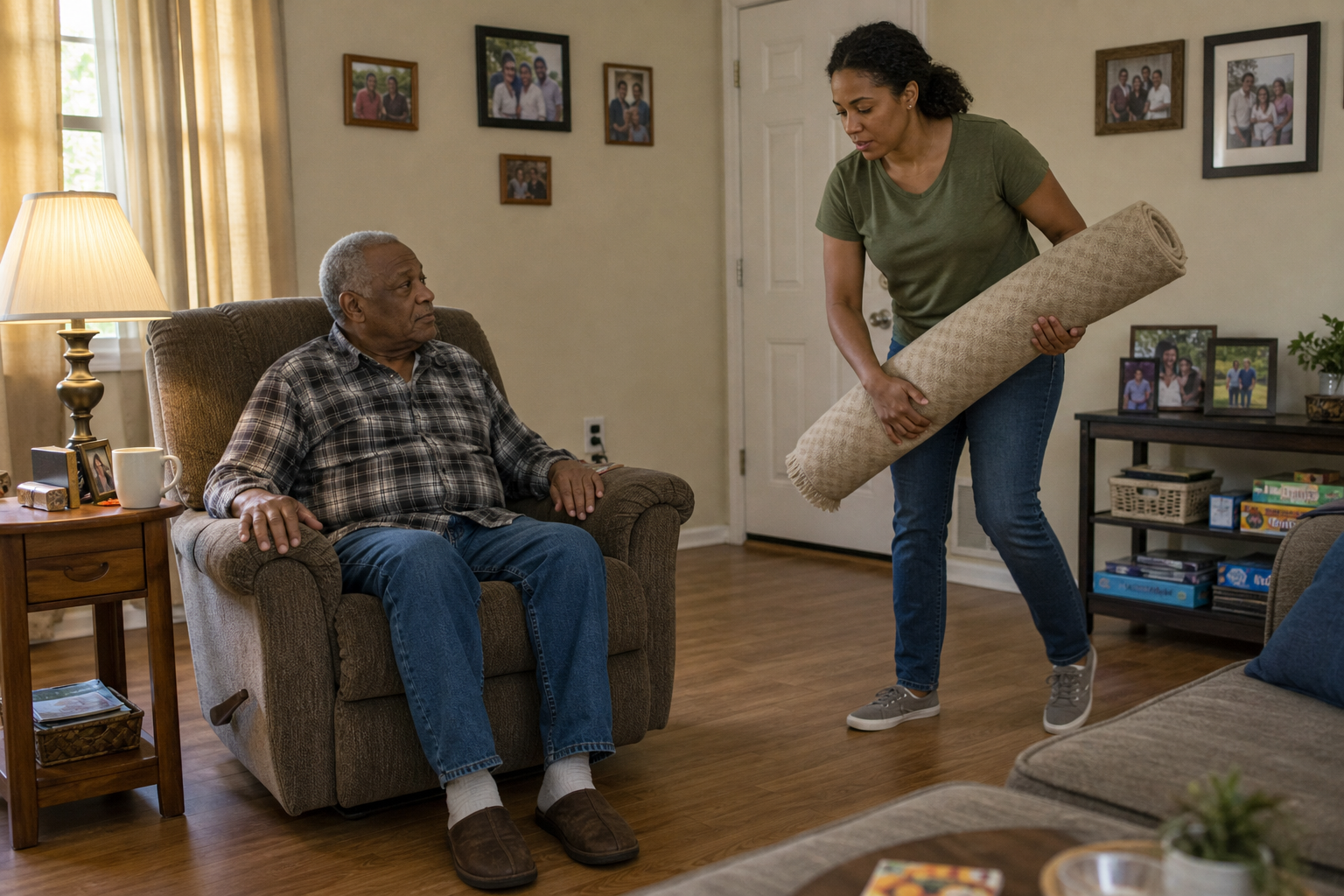
Those Coulda Woulda Shouldas can appear after a fall, a close call, a harsh word, a delayed decision, or a realization that something at home was riskier than it looked. Caregivers often look backward and see every missed clue more clearly than they saw it at the time.
That kind of regret can become exhausting. It can also make practical planning harder. When the mind keeps replaying what should have happened, it may become harder to see what can be changed now.
Some caregivers carry vivid memories of accidents that happened during completely ordinary moments. My mother once slipped on a braided runner rug she insisted on keeping on a stair because she thought it looked nice. She suffered a compound ankle fracture.
My father refused to use his walker during a transfer because he was proud and wanted to feel capable. His knee gave out and he fractured his femur from knee to hip. An artificial hip replacement acted almost like a splitting wedge during the fall.
Neither accident happened while I was there full-time. That reality matters. Caregivers are not always present when something goes wrong. Older adults also make independent decisions, sometimes risky ones, because they want to preserve normal routines, dignity, or a sense of control.
Those Coulda Woulda Shouldas often grow from moments exactly like these.
This page is not about pretending every decision was fine. It is about using regret carefully. Some regret contains useful information. Some of it is just punishment with a familiar voice.
How Those Coulda Woulda Shouldas Affect Caregiving Decisions
Those Coulda Woulda Shouldas usually show up after something has already gone wrong. A parent falls. A medication gets missed. A hallway turns out to be too dark. A caregiver realizes the throw rug near the chair had been curling for weeks.
The hard part is that caregiving decisions are rarely made with perfect information. Families make choices while tired, rushed, worried, or distracted. Sometimes everyone in the house is doing the best they can with a situation that keeps changing.
Regret can still point to something useful. It may show where a routine was too loose, where a room needed better lighting, or where a parent was quietly becoming less steady. The goal is to separate the useful signal from the useless self-blame.
A helpful question is simple:
“What would make this less likely to happen again?”
That question keeps the focus on action. It does not require a perfect explanation of the past.
Common Sources Of Those Coulda Woulda Shouldas
Those Coulda Woulda Shouldas often come from ordinary household moments, not dramatic failures. Most families are not ignoring obvious danger. They are adjusting slowly, sometimes too slowly, because the changes are uncomfortable to admit.
Common sources include:
- Not removing a rug sooner
- Waiting too long to add nightlights
- Assuming a parent was “just being careful”
- Dismissing small stumbles as clumsiness
- Putting off a hard conversation
- Leaving furniture crowded because the room looked familiar
- Accepting unsafe habits because arguing felt pointless
- Underestimating how much fatigue changes balance
These are not signs that someone failed as a caregiver. They are signs that home safety often becomes visible in pieces.
When Regret Points To A Real Safety Issue
Some regret deserves attention because it is attached to a specific, fixable problem. If the same issue keeps appearing in memory, look at the physical environment first.
Start with the exact place where the problem happened. Do not redesign the whole house in your head. Look at the floor, the chair, the lighting, the path, and the objects nearby.
Ask:
- Was the walking path too narrow?
- Was the light too dim?
- Was something being used for balance that could move?
- Was the person carrying too much?
- Was the floor surface slippery or uneven?
- Was the chair too low or too soft?
- Was there clutter in the turning space?
A small correction may matter more than a large plan. Move the table. Remove the rug. Add a lamp. Put commonly used items within easier reach. Clear the path between the bedroom, bathroom, kitchen, and favorite chair.
How To Avoid Turning Regret Into Panic
Those Coulda Woulda Shouldas can push families into overcorrection. After one frightening event, it is tempting to change everything at once. That can create new problems.
A parent may resist sudden changes because the house no longer feels like home. A caregiver may buy equipment that never gets used. A room may become crowded with “safety” items that make walking harder.
A calmer approach works better.
Change the most obvious hazard first. Then watch what happens. Does the person move more easily? Do they use the new lamp? Do they avoid the cleared pathway, or do they naturally follow it?
Good safety changes should make the house easier to use. They should not make ordinary movement feel like a supervised event.
Using Past Mistakes To Improve Daily Routines
Regret becomes useful when it leads to a better routine. A routine reduces the number of decisions everyone has to make when tired.
For example, nighttime walking is safer when the same lights are used every night, the same shoes or slippers are placed in the same spot, and the path stays clear. Morning routines are easier when glasses, hearing aids, medications, water, and walking aids are not scattered across the house.
The goal is predictability.
Helpful routines include:
- Checking walking paths before evening
- Keeping a phone within reach
- Placing frequently used items between waist and shoulder height
- Using the same chair for meals, reading, or watching television
- Keeping pet toys out of walking routes
- Limiting loose cords near sitting areas
- Making sure footwear is easy to find
Talking About Those Coulda Woulda Shouldas Without Blame
Talking about Those Coulda Woulda Shouldas can be difficult because older adults often hear safety concerns as criticism. Adult children may hear resistance as stubbornness. Both sides can become defensive quickly.
It helps to talk about the house, not the person.
Instead of saying, “You are going to fall if you keep doing that,” try, “This corner is tight when you turn with the walker. Let’s move the table a few inches.”
Instead of saying, “I told you that rug was dangerous,” try, “This rug is catching underfoot. I’m going to roll it up for now.”
The language matters. It keeps the conversation practical. It also avoids turning every safety concern into a debate about independence.
Independence is not helped by pretending the home has not changed. It is helped by making the home easier to use.
What To Change First After A Close Call
After a close call, do not start with guilt. Start with the scene.
Look at what the person was doing. Were they standing up from a chair? Turning in a hallway? Reaching into a cabinet? Walking in low light? Carrying laundry? Let the situation tell you what needs attention.
Good first changes are usually low-cost:
- Remove loose rugs
- Widen walking paths
- Add brighter bulbs
- Place lamps where switches are easy to reach
- Move unstable furniture out of grabbing range
- Reduce clutter near chairs and beds
- Keep shoes or slippers consistent
- Stop using rolling furniture as support
If the close call involved a fall, it may also be useful to review basic fall prevention guidance from a reliable public health source.
Keeping The Home Familiar While Making It Safer
One reason Those Coulda Woulda Shouldas linger is that safety changes can feel late, awkward, or even intrusive. A caregiver may know the house needs to change but hesitate because the parent is attached to how things have always been.
That is normal. Homes are emotional places. A chair is not always just a chair. A crowded shelf may represent years of habit, memory, and ownership.
Still, safety has to be practical. The best changes preserve familiarity while reducing risk.
Try small adjustments first:
- Shift furniture instead of replacing it
- Remove only the rug that causes trouble
- Add lighting without changing the whole room
- Clear one walking path at a time
- Keep favorite objects visible but out of the route
- Use baskets or trays to contain loose items
A safer home does not need to look empty. It needs to be easier to move through.
Turning Those Coulda Woulda Shouldas Into A Practical Next Step
Those Coulda Woulda Shouldas do not need to disappear before useful action can happen. A caregiver can feel regret and still make the next decision well.
The practical step is to choose one change that reduces repeated risk. Not ten changes. One real change.
Remove the object that keeps catching underfoot. Add the light that makes the hallway easier to see. Move the chair that blocks the turn. Put the walker where it can be reached before standing. Simplify the table next to the favorite seat.
Then watch the result.
If the change helps, keep it. If it creates a new problem, adjust it. Aging in place is not a single decision. It is a series of small corrections made as real life provides new information.
Those Coulda Woulda Shouldas are not useful when they become a private courtroom. They are useful when they help identify the next practical repair, the next safer habit, or the next honest conversation.
© 2026 Mark Fomenko. All rights reserved.
AgingInPlaceResource.com
Privacy Policy | Terms of Use | Disclaimer | Contact | Newsletter
Recent Articles


-
Aging In Place Resource Library
Sep 04, 26 08:30 AM
Aging In Place Resource Library -
Aging in Place Resource Newsletter
Aug 30, 26 11:16 AM
Aging in Place Resource Newsletter -
Aging in Place Resource: Simple Strategies for Living Safely at Home
Jul 28, 26 12:43 PM
 Aging in Place Resource provides practical guidance for aging in place. Learn how to live safely and independently at home with strategies for home safety, caregiving, planning, and long-term support.