Aging In Place Checklist
Here is a practical home safety checklist for adult children, parents, older adults, and families.
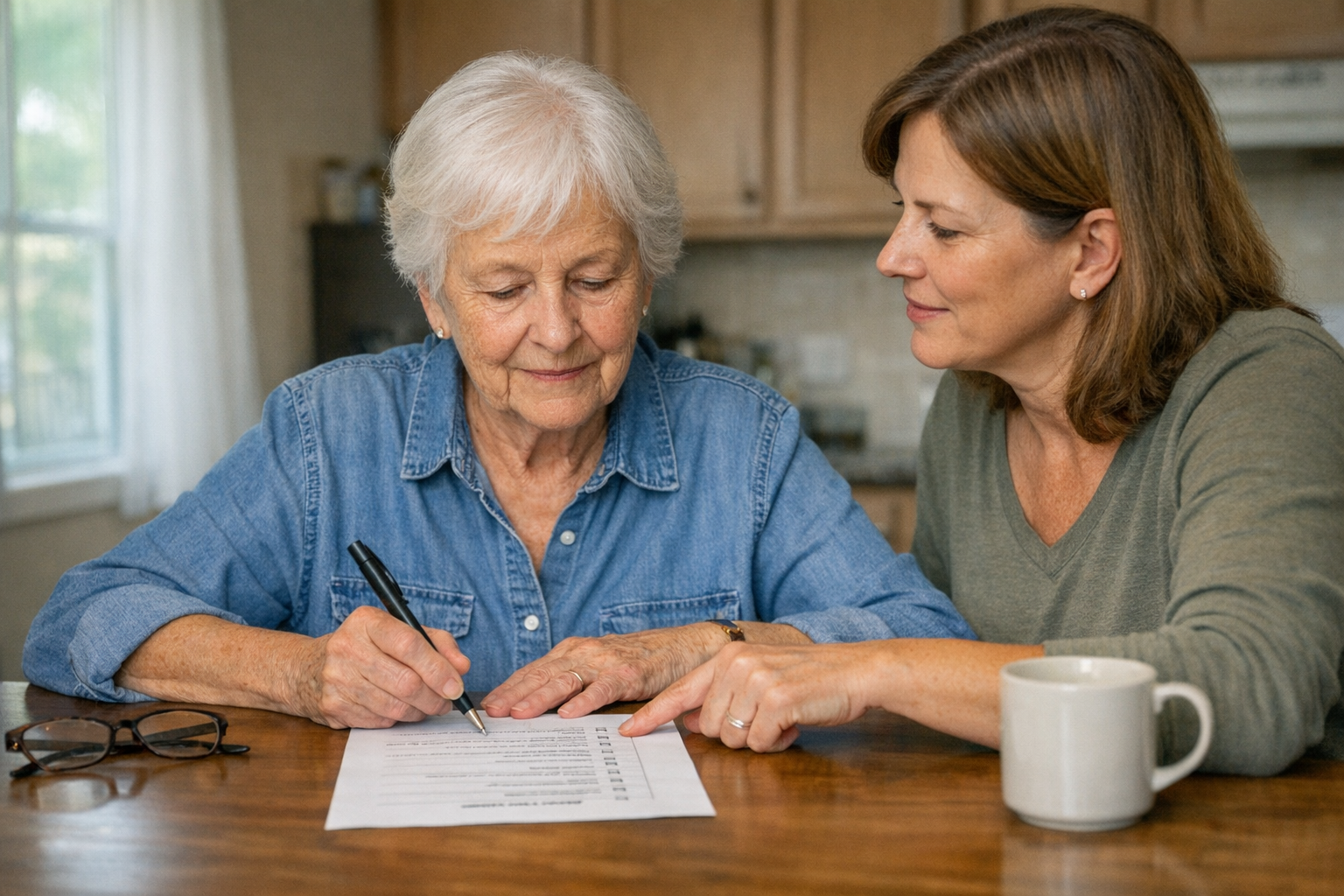
An aging in place checklist helps seniors to live safely and independently at home as needs change. This aging-in-place checklist helps you identify the risks that matter most, fix the simple problems first, and plan ahead before a fall, illness, or emergency forces rushed decisions.
Most aging-in-place problems are predictable. Falls, poor lighting, unsafe bathrooms, clutter, medication mistakes, and weak support systems often appear before a major crisis. The goal is not to make the home perfect. The goal is to make it safer, easier to move through, and more forgiving.
Use this page as your starting point. Walk through the home slowly. Make notes. Fix the obvious hazards first. Then use the related guides on this site for deeper help.
This aging-in-place checklist is meant to be used more than once. A home that feels safe today may need small changes after a fall, an illness, a change in medication, or a noticeable shift in balance, vision, memory, or strength.
Aging in place works best when minor safety issues are addressed before they become emergencies.
If you are new to aging-in-place planning, start with the Start Here page for a practical overview of senior home safety and long-term independence.
Many families discover that small safety improvements are only one part of the process. See our practical aging in place resources page for caregiving support, transportation assistance, financial programs, government checklists, and home safety guidance.
Aging in Place Guides provides a broader topic-based view of the site.
Start With The Biggest Risks
Fall Prevention
Use this part of the aging in place checklist to reduce the most common fall risks.
Check that:
- Floors are clear and dry
- Rugs are removed or secured
- Shoes fit well and have non-slip soles
- Stairs have sturdy handrails
- Rooms are bright enough to see obstacles
- Night lights are used between the bedroom and the bathroom
- Walkways are wide and simple
- Mobility aids are used correctly
- Chairs are easy to sit in and stand from
- The older adult is not rushing to answer phones, doors, or timers
Falls often happen during ordinary routines. Getting out of bed, walking to the bathroom, carrying laundry, stepping into the shower, or turning quickly in the kitchen can all become risky.
Related guide:
Dementia and Cognitive Decline
Cognitive decline can affect safety long before a formal diagnosis is received. Memory problems, confusion, poor judgment, medication mistakes, and changes in daily routines often develop gradually. Family members may notice subtle warning signs months or even years before a serious problem occurs.
Review the following:
- Repeatedly forgetting appointments or conversations
- Missing medications or taking incorrect doses
- Difficulty managing bills or paperwork
- Confusion while cooking or using appliances
- Getting lost in familiar places
- Wandering or exit-seeking behaviors
- Hallucinations, delusions, or unusual beliefs
- Increased difficulty following instructions
- Poor judgment regarding safety risks
- Increasing dependence on reminders from others
- Neglected housekeeping or personal hygiene
- Unopened mail, unpaid bills, or missed obligations
- Repeated stories or questions during the same conversation
- Difficulty completing familiar daily tasks
Families often discover that cognitive decline affects much more than memory. Judgment, decision-making, safety awareness, and the ability to manage everyday activities may also change over time.
Early planning is often easier than crisis management. Addressing concerns revealed by an aging in place checklist, while the older adult can still participate in decisions, may reduce stress for everyone involved later.
Related Guides:
Dementia Safety Checklist For Home
Cognitive Changes And Home Safety
Caregiving Support
Aging in place often depends on caregiving support as much as home safety. Even older adults who remain relatively independent may eventually need assistance with transportation, medications, meals, appointments, household tasks, or personal care.
Review the following:
- Reliable family or caregiver support is available
- Transportation to appointments can be arranged
- Groceries and prescription medications are being obtained consistently
- Important appointments are not being missed
- Household chores remain manageable
- Medications are being taken correctly
- There is a backup plan if the primary caregiver becomes unavailable
- Family members understand current care needs
- Care responsibilities are shared realistically when possible
- The caregiver is getting adequate rest and support
- Signs of caregiver stress or burnout are being recognized
- Increasing care needs are being discussed openly
Many caregiving challenges develop gradually. Family members often step in one task at a time until they suddenly realize they are managing medications, transportation, finances, meals, appointments, and household problems on a regular basis.
Pay attention to warning signs such as:
- Growing caregiver exhaustion
- Frequent frustration or conflict
- Missed appointments or medications
- Increasing safety concerns
- Declining personal health of the caregiver
- Situations that feel unsustainable
Successful caregiving is rarely the result of working harder. It is usually the result of creating practical routines, realistic expectations, and support systems that can be maintained over time.
Related Guide:
Preparing For Change
An aging in place checklist works best when families adapt gradually as needs change. Waiting until after a fall, hospitalization, dementia diagnosis, or caregiving crisis often limits available options and increases stress.
Review the following:
- The home can adapt to future mobility changes
- Transportation alternatives have been considered
- Important documents are organized and accessible
- Family members understand current and future support needs
- Emergency contacts are current
- Home repairs affecting safety are being addressed
- Financial and legal matters are reasonably organized
- Support resources have been identified before they become necessary
- Plans exist for increasing care needs
- Future living arrangements have been discussed if circumstances change
Pay attention to warning signs such as:
- Obvious safety problems are being ignored
- Necessary home repairs are repeatedly postponed
- Difficult conversations are continually avoided
- No backup plans exist for caregiving or transportation
- Family members have different assumptions about future care needs
- Decisions are being delayed despite noticeable changes in health, mobility, or cognition
Aging in place is not a one-time decision. It is an ongoing process of adapting to change while maintaining safety, independence, and quality of life.
Related Guides:
Preparing For Increasing Care Needs
How Often To Review Your Aging In Place Checklist
An aging in place checklist should be reviewed regularly because health, mobility, vision, balance, memory, and daily routines often change gradually over time. A home that was reasonably safe six months ago may no longer fit the person's current needs.
Many families wait until after a fall, hospitalization, or medical emergency to reassess the home. It is usually better to review conditions before a crisis develops.
As a general rule, review the checklist:
- Every 6 to 12 months during stable periods
- After any fall or near-fall
- After hospitalization or surgery
- When mobility changes
- When a walker, cane, or wheelchair becomes necessary
- When medications change significantly
- When memory or judgment problems become noticeable
- When caregiving needs increase
- When rooms begin going unused because movement has become difficult
Small changes are important. An older adult may begin holding onto furniture while walking, avoiding stairs, forgetting medications, leaving lights off at night, or struggling with transfers long before a serious injury occurs.
The aging in place checklist review process does not need to be formal or complicated. Walk through the home slowly and observe how daily life is actually functioning.
Pay close attention to:
- Walking paths
- Lighting
- Bathroom safety
- Stair use
- Kitchen organization
- Chair and bed transfers
- Clutter buildup
- Emergency access
- Fatigue during daily routines
- Changes in balance, strength, or reaction time
It is also helpful to ask practical questions:
- Is the person rushing to the bathroom at night?
- Are frequently used items easy to reach?
- Has cooking become more difficult?
- Are medications being taken correctly?
- Is housekeeping becoming harder to maintain?
- Has the person stopped using parts of the home?
The checklist should evolve with the person's condition. Aging in place is not a one-time setup. It is an ongoing process of adjustment, observation, and practical problem-solving.
For more detailed guidance, see: How Adult Children Can Assess the Home of Aging Parents
What To Fix First
When improving home safety for aging in place, it is usually best to fix the highest-risk problems first instead of trying to change everything at once. Small practical improvements made early can significantly reduce the risk of falls, injuries, and daily stress.
The first priority should always be hazards most likely to cause serious injury.
In many circumstances, the highest-risk issues include:
- Bathrooms
- Bedrooms
- Stairs
- Poor lighting
- Loose rugs and floor clutter
- Unsafe furniture arrangements
- Difficult transfers from beds, chairs, or toilets
- Signs of Cognitive Decline and Dementia
- Signs of Fall Risk
Bathrooms are often the most urgent places to address because wet floors, tight spaces, and rushed movement create a high risk of falls. Simple improvements like grab bars, non-slip mats, brighter lighting, and safer toilet transfers can make a major difference.
Stairs should also be reviewed early. Loose railings, poor lighting, cluttered steps, and carrying objects while climbing stairs all increase the risk of injury.
Next, focus on walking safety throughout the home. Clear pathways are extremely important. Older adults should be able to move from room to room without stepping around cords, boxes, unstable furniture, pet items, or clutter.
Lighting improvements are often inexpensive and highly effective. Hallways, bedrooms, bathrooms, and entrances should be easy to see during both daytime and nighttime hours.
After major safety hazards are addressed, attention can shift toward making daily routines easier and less physically demanding.
Examples include:
- Reorganizing kitchens
- Improving bedroom layouts
- Reducing bending and reaching
- Making medications easier to manage
- Simplifying frequently used storage areas
- Improving chair and bed transfers
Families should avoid becoming overwhelmed by trying to create a perfect home immediately. Aging in place usually works better when improvements happen gradually and realistically over time.
The goal is not perfection. The goal is to reduce unnecessary risk while making everyday life safer, calmer, and easier to manage.
For more detailed guidance, see: How To Make A Home Safer Without Remodeling
Where To Go Next
An aging in place checklist is a starting point, not a final solution. After reviewing the home and identifying major concerns, the next step is to focus on the areas most relevant to the older adult’s current needs, routines, and health challenges.
Some families need to focus primarily on fall prevention. Others may need help with caregiving, cognitive changes, mobility issues, or safely managing daily routines at home.
A practical next step is to work through the home category by category instead of trying to solve everything at once.
Many people begin with:
- Bathroom safety
- Fall prevention
- Bedroom safety
- Kitchen organization
- Daily routines
- Transfer safety
- Decluttering and walking paths
- Caregiving systems and support
It is also important to recognize that aging in place changes over time. Needs that seem minor today may become much more important after illness, hospitalization, fatigue, or changes in mobility.
Families should continue observing:
- Balance and walking stability
- Memory and judgment
- Difficulty with stairs
- Changes in cooking habits
- Medication management
- Fatigue during ordinary activities
- Increasing dependence on caregivers
- Rooms or activities are being quietly avoided
The goal is not simply to keep someone in the home as long as possible, regardless of circumstances. The goal is to make daily life safer, more manageable, and more dignified while reducing unnecessary stress for both the older adult and the caregiver.
The following page provides more detailed guidance on important aging-in-place topics:
Small practical improvements made consistently over time are often more effective than large changes made too late.
Helpful External Resources
Many organizations provide free information, checklists, guides, and educational materials related to aging in place, caregiving, fall prevention, mobility, and senior home safety. These resources can help families make practical decisions and better understand common challenges associated with aging at home.
Government and nonprofit resources are often especially useful because they focus on safety, public health, caregiving support, and long-term independence rather than selling products or services.
Helpful topics include:
- Fall prevention
- Medication safety
- Home modification ideas
- Caregiving support
- Mobility and transfer safety
- Vision and hearing changes
- Cognitive decline and dementia
- Emergency preparedness
- Nutrition and hydration
- Healthy aging
Useful external resources include:
- The National Institute on Aging (NIA)
- The Centers for Disease Control and Prevention (CDC) Healthy Aging Program
- The Administration for Community Living (ACL)
- The National Council on Aging (NCOA)
- Local Area Agencies on Aging
- State health departments and senior services programs
- Occupational therapy and rehabilitation resources
- Veterans services for eligible families
Many organizations also provide downloadable PDFs, caregiver guides, printable checklists, and home safety assessments that families can review together.
When using outside resources, focus on practical information that improves safety and daily living. Avoid becoming overwhelmed by complicated systems, excessive medical jargon, or expensive recommendations that are unrealistic for the home and family situation.
The most useful guidance is usually:
- Simple
- Affordable
- Repeatable
- Easy to understand
- Easy to maintain over time
Families should remember that aging in place is not about creating a perfect environment. It is about making thoughtful adjustments that help daily life remain safer, calmer, and more manageable.
For more detailed guidance, see: Aging In Place Resources
Getting Oriented
Aging in place can feel overwhelming at first, especially for families suddenly dealing with falls, illness, mobility problems, memory changes, or caregiving responsibilities. Many people are unsure where to begin or which problems to address first.
Many adult children do not fully recognize how much their parents have declined until they visit in person after months or years apart. Phone calls can hide mobility problems, poor housekeeping, weight loss, memory changes, medication confusion, or unsafe living conditions surprisingly well. During a visit, the signs often become obvious very quickly: spoiled food in the refrigerator, cluttered walkways, unpaid bills, repeated stories, difficulty standing, forgotten appointments, or visible exhaustion from ordinary tasks.
This realization can feel emotionally overwhelming, especially when the adult child lives far away and cannot easily provide daily support. The best response is usually not panic, guilt, or confrontation. It is to begin calmly observing the situation, identifying the most immediate safety concerns, and making practical improvements one step at a time.
The most important thing is to start with practical observation. Walk through the home slowly and pay attention to how daily life is actually functioning.
Look for:
- Difficulty walking safely
- Cluttered pathways
- Poor lighting
- Bathroom fall risks
- Unsafe stairs
- Difficulty getting in and out of chairs or beds
- Confusion with medications or cooking
- Fatigue during ordinary tasks
- Changes in memory, judgment, or balance
Many aging-in-place problems develop gradually. Families often adapt to small changes without realizing how much daily functioning has declined over time.
It is also important to understand that aging in place is not simply about remaining at home at all costs. The goal is to create a living situation that is safer, more manageable, and less physically and emotionally stressful for everyone involved.
Most families benefit from focusing on:
- Fall prevention
- Daily routines
- Simplifying the home environment
- Reducing physical strain
- Supporting independence where possible
- Improving communication and caregiving systems
- Making small practical improvements consistently over time
Do not try to solve everything immediately. The best approach is usually gradual and realistic. Small improvements often create meaningful gains in safety and quality of life.
Families should also avoid the common mistake of focusing only on emergencies.
Quiet patterns often matter more:
- Increasing fatigue
- Avoiding certain rooms
- Poor nutrition
- Declining housekeeping
- Repeated near-falls
- Difficulty with transfers
- Reduced activity and isolation
These changes often appear long before a major medical crisis occurs.
The following page provides a practical starting point for learning more about aging in place and improving home safety: Start Here
Final Thought
The best aging in place checklist is not just a list of repairs. It is a way to notice change early. When the home is safer, daily routines are easier, family stress is lower, and independence lasts longer.
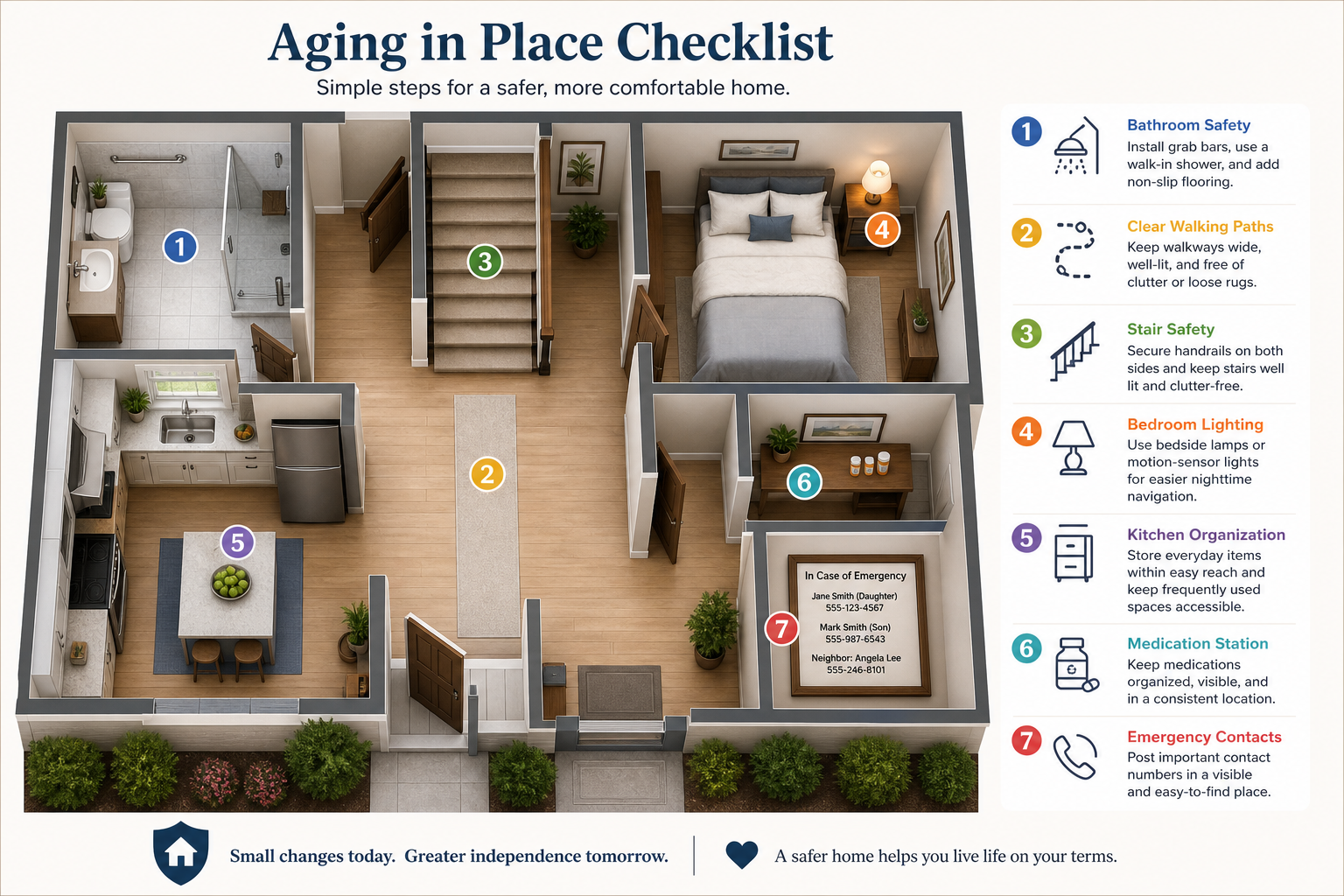
Aging in place checklist graphic showing key home safety areas, including bathroom safety, lighting, walkways, stairs, kitchen organization, medications, and emergency planning.
© 2026 Mark Fomenko. All rights reserved.
AgingInPlaceResource.com
Privacy Policy | Terms of Use | Disclaimer | Contact | Newsletter
Recent Articles


-
Aging In Place Resource Library
Sep 04, 26 08:30 AM
Aging In Place Resource Library -
Aging in Place Resource Newsletter
Aug 30, 26 11:16 AM
Aging in Place Resource Newsletter -
Aging in Place Resource: Simple Strategies for Living Safely at Home
Jul 28, 26 12:43 PM
 Aging in Place Resource provides practical guidance for aging in place. Learn how to live safely and independently at home with strategies for home safety, caregiving, planning, and long-term support.