How To Make Stairs Safer For Seniors Without Remodeling
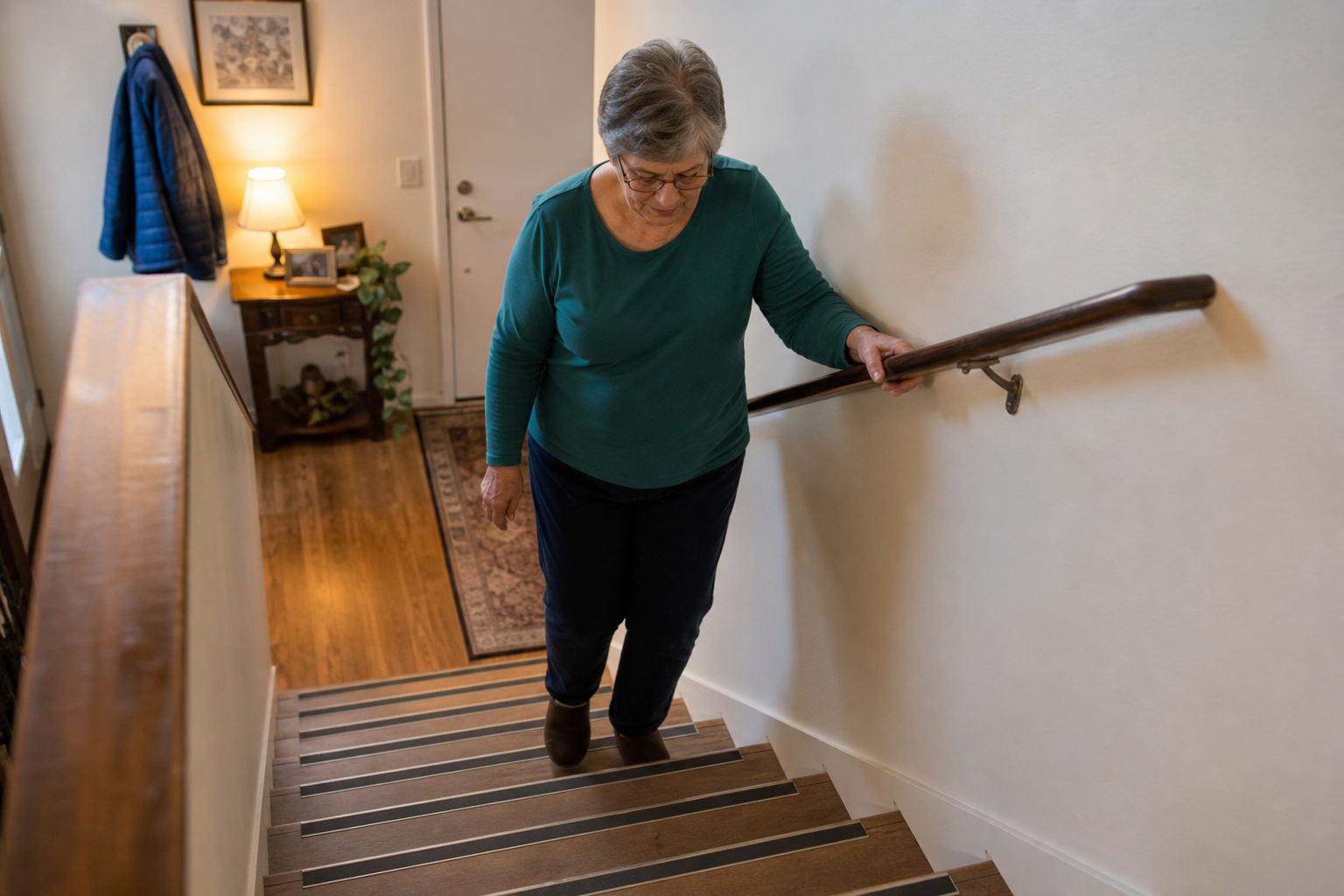
Stairs can become one of the hardest parts of staying safely at home, especially when balance, vision, strength, or confidence begins to change. How To Make Stairs Safer For Seniors Without Remodeling is about reducing risk with practical changes that do not require tearing out walls, rebuilding staircases, or buying expensive equipment.
The goal is not to make the home look perfect. The goal is to make every trip up and down the stairs easier to see, easier to grip, and easier to manage. Most stair safety improvements are simple, affordable, and based on how people actually move through the home every day.
How To Make Stairs Safer For Seniors Without Remodeling By Fixing The Main Fall Risks
The biggest stair risks usually come from poor visibility, weak hand support, clutter, rushing, and carrying too much.
Stairs demand more from the body than flat floors. A person has to lift the foot high enough, judge the edge of each step, shift weight smoothly, and keep balance while moving upward or downward. Even a small distraction can matter. A dim hallway, a loose slipper, a laundry basket, or a missing handrail can turn an ordinary staircase into a daily hazard.
Start by watching how the stairs are actually used. Notice whether the person reaches for the wall, pauses before stepping down, grips the rail tightly, or avoids the stairs late in the day. These observations are more useful than guessing.
Practical first steps include:
- Remove shoes, bags, mail, and laundry from every step.
- Check whether each step edge is easy to see from above and below.
- Make sure the handrail can be reached before the first step.
- Keep pets away from the staircase during stair use.
- Encourage slower movement instead of rushing between rooms.
How To Make Stairs Safer For Seniors Without Remodeling begins with reducing ordinary mistakes before adding products.
Improve Stair Lighting Before Buying Anything Expensive
Better lighting is one of the cheapest stair safety improvements.
Many falls happen because the person cannot clearly see where one step ends and the next begins. This is especially true at night, early in the morning, or in homes where the stairwell relies on a single weak ceiling light. Shadows can hide the edge of a step. Glare can also be a problem if a bulb is too bright or aimed poorly.
Use steady, even lighting from top to bottom. The person should not have to cross the room in the dark to reach the switch. If the stairway has only one switch, a plug-in motion light or battery-powered light near the landing may help.
Useful lighting changes include:
- Replace weak bulbs with brighter bulbs that fit the fixture safely.
- Add motion-sensor night lights near the top and bottom landings.
- Keep light switches easy to reach before stepping onto the stairs.
- Use warm, even lighting instead of harsh glare.
- Check the stairway at night to see what the person actually sees.
How To Make Stairs Safer For Seniors Without Remodeling often starts with making the staircase visible before changing anything else.
Home Lighting Safety For Seniors
Make Handrails Easier To Use Every Time
A stair rail must be easy to grip, steady, and continuous enough to support real movement.
A decorative rail that is hard to hold is not enough. The hand should be able to comfortably wrap around the rail. If the rail is loose, too short, too wide, or blocked by furniture at the landing, it may not provide reliable support when balance shifts.
Check both sides of the staircase if possible. Many older homes have only one rail. That may be workable for some people, but it can be a problem if the person has one stronger side, carries a cane, or feels less stable going down than going up. Adding a second rail may be a modest improvement compared with larger remodeling projects.
Look for these handrail issues:
- Tighten any rail that moves when pulled.
- Keep the rail clear of coats, bags, decorations, or cords.
- Make sure the rail extends close to the first and last step.
- Choose a rail shape that can be gripped, not just touched.
- Avoid glossy finishes that become slippery.
A page on Stair Safety For Seniors can support this decision when the main concern is daily stair navigation.
Use Contrast To Make Step Edges Easier To See
Clear contrast helps the brain judge depth and distance.
When stairs are all one color, each step can blend into the next. This becomes more noticeable with reduced vision, bifocals, poor lighting, or patterned carpeting. The person may hesitate at the top step because the first drop is hard to judge. Going down is usually more difficult than going up because each step must be located before weight shifts forward.
Low-cost contrast can make a major difference. The goal is not decoration. The goal is to mark the front edge of each step clearly enough that the foot knows where to land. Use materials that stay flat and do not create a new tripping edge.
Possible contrast improvements include:
- Add non-slip contrast tape to the front edge of each step.
- Use a clearly different color from the stair surface.
- Avoid shiny tape that creates glare.
- Replace worn or curled tape immediately.
- Keep patterns simple so the steps do not look visually busy.
How To Make Stairs Safer For Seniors Without Remodeling should include visibility from both directions. Stand at the top and bottom of the stairs and check whether the edges are clear.
Keep Stair Surfaces Firm, Flat, And Predictable
The walking surface on each step should feel stable underfoot.
Loose carpet, worn stair treads, curled mats, and slick wood can all increase risk. A stair surface does not have to be new to be safer. It does need to be even, secure, and easy to step on without sliding. Small defects matter more on stairs than on flat floors because the foot lands on a narrower surface.
Pay close attention to the landing areas, too. A rug at the bottom of the stairs can slip just as someone steps off the last stair. A curled runner near the top can catch a toe before the person even reaches the staircase.
Check the stair surfaces this way:
- Press down on each tread to feel for loose carpet or movement.
- Remove small rugs near the top or bottom landing.
- Replace slick socks or slippers with secure footwear.
- Fix curled stair nosing, loose tape, or raised edges.
- Keep stair runners tight, flat, and firmly attached.
Flooring Safety For Seniors is closely related when the problem extends beyond the staircase to nearby walking surfaces.
Change Carrying Habits On The Stairs
Carrying objects on stairs should be treated as a separate safety issue.
Many people fall not because the stairs are unusual, but because their hands are full. Laundry baskets, grocery bags, packages, cups, books, and pet supplies all interfere with balance. They block the view of the steps and prevent the person from using the handrail properly. A person who is still fairly steady on stairs may become unsafe when carrying awkward items.
The safest habit is simple: keep one hand free for the rail whenever possible. That may require changing where supplies are stored or how items are moved between floors.
Helpful changes include:
- Use a small shoulder bag instead of carrying loose items by hand.
- Move laundry in smaller loads instead of one heavy basket.
- Keep duplicate supplies upstairs and downstairs when practical.
- Avoid carrying hot drinks on stairs.
- Ask family members to move bulky items during visits.
For general fall prevention guidance, MedlinePlus has a useful overview at https://medlineplus.gov/ency/patientinstructions/000021.htm
Reduce Rushing, Distraction, And Poor Timing
Safe stair use depends as much on timing as on the staircase itself.
Stairs are riskier when someone is tired, distracted, upset, in a hurry, or half awake. Morning stiffness, evening fatigue, nighttime bathroom trips, and sudden phone calls can all change how safely a person moves. The staircase may be manageable at noon, but much harder at 2 a.m.
A practical stair plan should reduce unnecessary trips. Items used daily should be stored where they are most often needed. Phones, chargers, medications, tissues, water, and reading glasses should not require repeated trips up and down the stairs if they can be placed more thoughtfully.
Useful habit changes include:
- Pause before using the stairs instead of stepping automatically.
- Turn on lights before reaching the first step.
- Keep one hand on the rail from start to finish.
- Avoid stair use when rushing to answer the door or phone.
- Plan upstairs and downstairs tasks in batches.
How To Make Stairs Safer For Seniors Without Remodeling is partly about changing the home and partly about changing the rhythm of movement. Stair safety belongs within the broader context of aging in place and fall prevention because a single risky staircase can affect bathroom and bedroom access, laundry routines, and daily independence. A practical Aging in Place Checklist helps connect these small stair changes to the rest of the home.
Make The Landing Areas Safer And Easier To Use
The top and bottom of the stairs need as much attention as the steps.
Many stair falls begin before the first step or after the last one. A crowded landing, poor lighting, narrow turn, loose rug, or poorly placed table can interrupt balance at the exact moment the person is changing direction. The landing should allow a calm pause, a clear turn, and an easy reach for the handrail.
Think of each landing as a small transition zone. It should not be used as storage. Shoes, packages, pet toys, baskets, and folded laundry do not belong there. If the person needs a place to pause, keep the area simple and open rather than adding furniture that narrows the path.
Practical landing improvements include:
- Remove storage items from the top and bottom landings.
- Keep the first step visible from the hallway.
- Make sure nearby doors do not swing into the walking path.
- Place light switches where they can be reached safely.
- Keep pets, cords, and small objects out of the landing area.
How To Make Stairs Safer For Seniors Without Remodeling works best when the entire stair path is treated as one movement zone, not just a set of steps.
© 2026 Mark Fomenko. All rights reserved.
AgingInPlaceResource.com
Privacy Policy | Terms of Use | Disclaimer | Contact | Newsletter
Recent Articles


-
Aging In Place Resource Library
Sep 04, 26 08:30 AM
Aging In Place Resource Library -
Aging in Place Resource Newsletter
Aug 30, 26 11:16 AM
Aging in Place Resource Newsletter -
Aging in Place Resource: Simple Strategies for Living Safely at Home
Jul 28, 26 12:43 PM
 Aging in Place Resource provides practical guidance for aging in place. Learn how to live safely and independently at home with strategies for home safety, caregiving, planning, and long-term support.