Home Safety Assessment Checklist For Elderly Parents
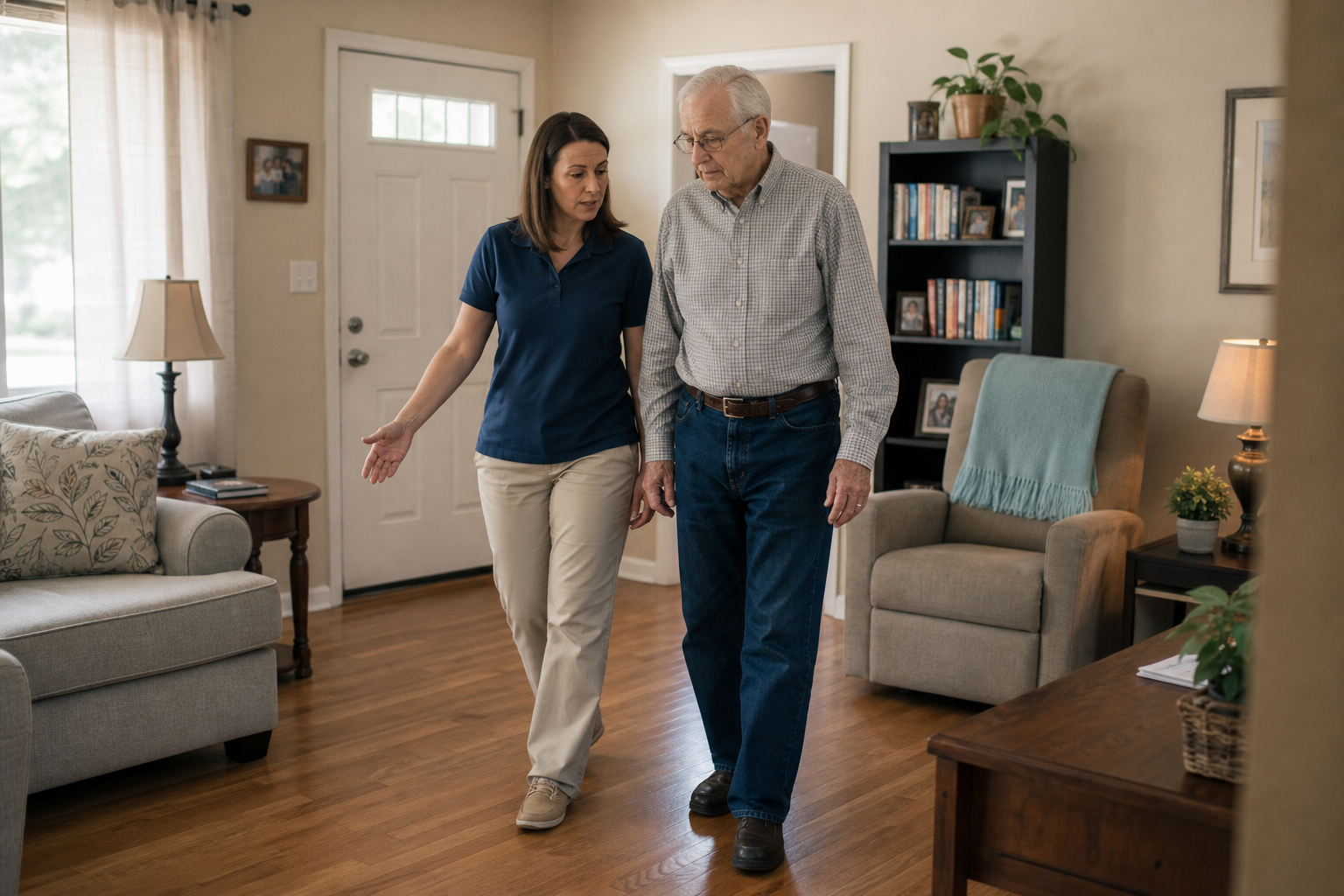
Home Safety Assessment Checklist For Elderly Parents is one of the most practical tools families can use before a crisis develops. Many adult children notice small changes during visits. A parent hesitates on the stairs, struggles to rise from a favorite chair, or leaves items scattered across walking paths. None of these issues alone necessarily means someone can no longer live safely at home, but together they often indicate that the home deserves a closer look.
A thorough assessment is not about finding fault. It is about identifying hazards that have quietly become part of everyday life. Most improvements are inexpensive and involve better organization, improved lighting, removing obstacles, or changing daily routines rather than expensive remodeling. The goal is to support independence while reducing unnecessary risks.
Home Safety Assessment Checklist For Elderly Parents: Where To Begin
A good Home Safety Assessment Checklist For Elderly Parents starts with observation rather than assumptions.
Visit the home at different times of day if possible. A hallway that seems bright during the afternoon may become difficult to navigate after sunset. Watch how your parent naturally moves through the home instead of asking them to demonstrate.
Look for signs such as:
- Difficulty standing from chairs
- Holding onto furniture while walking
- Clutter narrowing walking paths
- Poor lighting
- Loose rugs
- Extension cords across floors
- Frequently used items stored on high shelves
- Shoes left beside doorways
- Unstable furniture used for support
Pay attention to routines. Many hazards appear during ordinary daily activities rather than unusual situations.
Walking Paths And Everyday Movement
Most falls occur while performing familiar activities.
Walk through the house as though you were your parent. Carry a laundry basket. Bring groceries inside. Walk from the bedroom to the bathroom at night. These ordinary movements often reveal hazards that are easy to overlook.
Walking paths should be:
- Wide enough for walkers or canes
- Free of electrical cords
- Free of boxes and decorative furniture
- Easy to navigate without sharp turns
- Well lit throughout the day and night
Furniture should allow direct movement between commonly used rooms.
Avoid placing decorative tables, plants, baskets, or magazine racks where someone naturally walks.
Evaluating Each Room With A Home Safety Assessment Checklist For Elderly Parents
Every room deserves individual attention because each presents different challenges.
The kitchen should allow frequently used cookware, dishes, and food to be reached without climbing or excessive bending.
Bedrooms should provide clear access to both sides of the bed whenever practical. Nightstands should be sturdy enough to support normal use without encouraging someone to rely on them for standing.
Bathrooms deserve particularly careful attention because water, smooth flooring, and frequent transfers combine to create one of the highest fall risks in the home.
Look throughout the house for:
- Loose flooring
- Poor contrast between floors and steps
- Inadequate lighting
- Worn carpeting
- Furniture with sharp corners narrowing pathways
- Pets that frequently sleep in walking areas
- Frequently used objects stored in awkward locations
Bathroom Safety For SeniorsLighting, Visibility, And Nighttime Safety
Lighting problems often develop gradually.
Older adults generally require more light than younger people, yet many homes remain illuminated exactly as they were decades earlier.
Improve visibility by:
- Replacing dim bulbs
- Adding night lights between the bedroom and bathroom
- Increasing lighting over stairs
- Reducing glare from uncovered windows
- Making light switches easy to reach
Nighttime bathroom trips deserve special attention.
Many falls occur because someone is sleepy, rushing, or reluctant to turn on bright overhead lighting. A series of low-level night lights can make nighttime walking much safer without disturbing sleep.
Simple improvements in visibility frequently provide significant safety benefits.
Furniture, Seating, And Transfer Safety
One of the easiest ways to evaluate mobility is simply to watch your parent go through an ordinary day.
Don't ask them to "show you" how they stand up. Instead, observe what happens naturally while having coffee, watching television, or getting ready for bed. People often compensate for declining strength without realizing they are doing it.
Notice how they get in and out of bed, rise from a favorite recliner, stand from the dining table, get off the sofa, and use the toilet. If every transfer requires rocking forward several times, pushing hard on the armrests, or grabbing nearby furniture, the effort required for everyday activities may be increasing.
Low, soft chairs often become surprisingly difficult to stand from because they require more leg strength than firm, higher seating. Many older adults continue using the same favorite chair long after it has become physically challenging. Sometimes simply replacing one chair with a firmer model or adding a properly designed seat cushion can make standing much easier.
Watch for unstable turning movements. Someone may stand safely but become unsteady when turning toward a walker, reaching for a cane, or carrying an object to another room. These moments often reveal balance problems that are not obvious while walking in a straight line.
Furniture placement also deserves careful attention. Coffee tables, decorative plant stands, magazine racks, and extra chairs can gradually create narrow pathways that require frequent twisting and sidestepping. A room should allow someone to move naturally without constantly changing direction or squeezing between obstacles.
Many older adults begin using furniture for balance without consciously thinking about it. A hand briefly touching the back of a sturdy chair while walking is not unusual. However, if someone routinely pulls themselves across a room by grabbing tables, counters, or unstable furniture, it usually indicates that walking has become more difficult than they are willing to admit.
Frequently used items should also support safe movement. Glasses, telephones, medications, remote controls, reading materials, and charging cables should remain within comfortable reach. Repeated bending, stretching across tables, or walking back and forth to retrieve forgotten items creates dozens of unnecessary opportunities for falls over the course of a week.
For additional home safety information, see the CDC's guidance.
Making Improvements Without Major Remodeling
Most families are relieved to discover that a safer home usually does not require expensive remodeling.
During the years I cared for my parents, the biggest improvements often came from moving things rather than buying things. The goal was to make everyday movements easier and more predictable.
Start by looking at how the home is actually used instead of how it was originally furnished. Many older adults continue walking around furniture that no longer serves any practical purpose.
Decorative tables, extra chairs, magazine racks, large plants, and storage baskets can gradually narrow walking paths without anyone noticing because they have "always been there."
Storage deserves the same attention. Frequently used items should not require climbing onto stools, kneeling on the floor, or reaching into the back of deep cabinets. Coffee mugs, medications, toiletries, favorite cookware, and everyday clothing should all be located where they can be reached comfortably while standing in a stable position.
Lighting improvements are usually inexpensive and have an immediate effect. A brighter bulb over the basement stairs, motion-activated lighting near an entry door, or several small night lights between the bedroom and bathroom may prevent a fall that otherwise would have seemed like bad luck.
Clutter tends to accumulate gradually, especially when mobility becomes more difficult. Newspapers, delivery boxes, laundry baskets, pet supplies, and electrical cords often migrate into walking areas simply because moving them becomes less of a priority. An objective walkthrough can identify obstacles that the homeowner has stopped noticing.
Medication management is another surprisingly common issue. Bottles stored in multiple bathrooms, kitchen cabinets, bedroom drawers, and purses make it much easier to lose track of what has already been taken. Keeping medications in one organized location, when appropriate, simplifies daily routines and reduces confusion.
None of these changes are dramatic by themselves. Their value comes from reducing dozens of small physical challenges that occur every day. A wider walking path, better lighting, easier storage, and fewer unnecessary obstacles can make a home feel noticeably safer without changing how it feels to live there.
Repeating The Home Safety Assessment Checklist For Elderly Parents
A Home Safety Assessment Checklist For Elderly Parents should not be viewed as a one-time project.
Health, vision, balance, strength, and mobility change gradually. A home that was reasonably safe two years ago may now contain several hazards that have quietly accumulated.
Repeat your assessment after:
- A fall
- A hospitalization
- New mobility equipment
- Medication changes
- Significant vision changes
- Noticeable changes in strength or balance
Regular observation allows families to make small adjustments before problems become emergencies.
The objective is not to create a perfect home. It is to create a home that continues supporting safe, practical, and independent living for as long as reasonably possible.
© 2026 Mark Fomenko. All rights reserved.
AgingInPlaceResource.com
Privacy Policy | Terms of Use | Disclaimer | Contact | Newsletter
Recent Articles


-
Aging In Place Resource Library
Sep 04, 26 08:30 AM
Aging In Place Resource Library -
Aging in Place Resource Newsletter
Aug 30, 26 11:16 AM
Aging in Place Resource Newsletter -
Aging in Place Resource: Simple Strategies for Living Safely at Home
Jul 28, 26 12:43 PM
 Aging in Place Resource provides practical guidance for aging in place. Learn how to live safely and independently at home with strategies for home safety, caregiving, planning, and long-term support.