Helping Aging Parents Accept Help
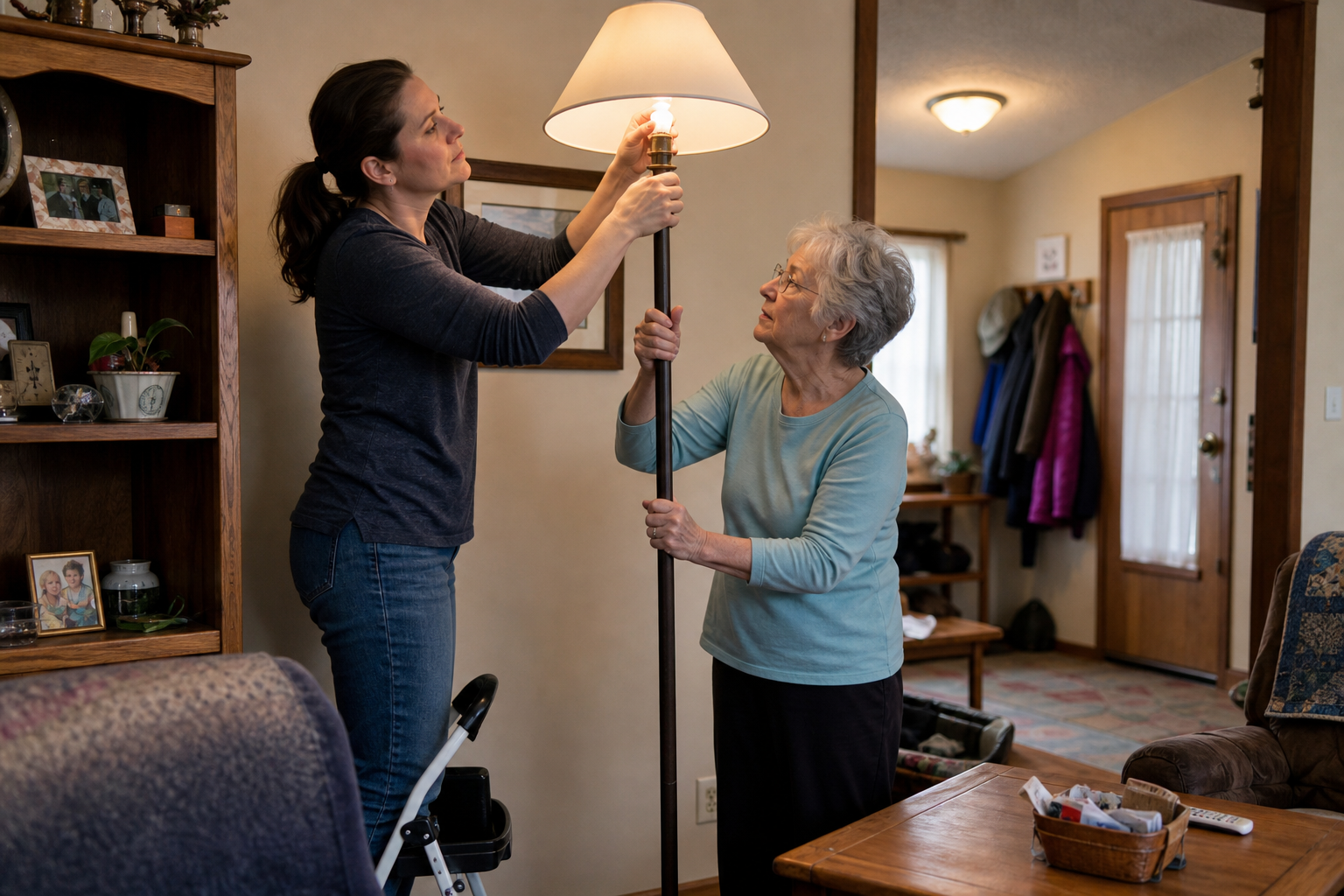
Helping Aging Parents Accept Help is often difficult because the real issue is not just cooperation. It is safety, independence, pride, habit, and fear of losing control inside a familiar home.
Small refusals can create real risk. A parent who will not use better lighting, remove a loose rug, adjust a chair, accept help with laundry, or carry a phone indoors may face preventable falls and daily strain. The goal is not to take over. The goal is to make help feel practical, affordable, and connected to staying independent longer.
The best approach usually starts with the home itself. When help is framed as a safety improvement rather than a personal failure, resistance often softens.
Helping Aging Parents Accept Help Starts With Safer Movement At Home
The first safety issue is movement through the home.
Most resistance shows up around ordinary tasks. Your parent may insist they are “fine” walking to the bathroom at night, carrying groceries, reaching into high cabinets, or using stairs with one hand full. These habits may have worked for years, but aging in place depends on adjusting the environment before a bad fall forces bigger decisions.
Start by observing movement, not arguing about age. Watch how your parent stands from a chair, turns in a hallway, steps over thresholds, reaches for support, and walks when tired. This keeps the conversation grounded in visible safety rather than opinion.
Useful first steps include:
- Move shoes, bags, baskets, and cords out of walking paths.
- Place a sturdy chair near the entryway for changing shoes.
- Add brighter bulbs to hallways, staircases, and bedrooms.
- Put frequently used items between waist and shoulder height.
- Remove or secure rugs that slide, curl, or bunch.
- Keep a phone within reach in the rooms used most often.
Helping Aging Parents Accept Help works better when the first changes are small, cheap, and obviously useful.
Start With One Practical Problem Instead Of A Big Conversation
A large conversation can feel like a threat.
Many adult children make the mistake of trying to solve everything at once. They mention driving, stairs, medication, clutter, finances, bathing, food, and future care in one stressful discussion. That can make a parent defensive even when the concerns are valid.
Pick one physical problem that is easy to see and easy to fix. A dark hallway, a wobbly chair, an overloaded laundry basket, or a slippery bath mat is better than a broad lecture about aging. The smaller the first request, the easier it is for your parent to say yes without feeling defeated.
Try language that focuses on the task:
- “Let’s put a brighter bulb here so this hallway is easier at night.”
- “Let’s move these pans lower so you do not have to reach overhead.”
- “Let’s put a chair here so carrying bags inside is easier.”
- “Let’s clear this path so nobody trips on the way to the bathroom.”
Helping Aging Parents Accept Help often begins with one accepted change. Once one improvement proves useful, the next one usually feels less intrusive.
Make Help Feel Like Independence, Not Supervision
Most parents resist help when it feels like being watched.
The wording matters. “You need help” can sound like a loss of authority. “Let’s make this easier” is less threatening. “I do not want you living alone unsafely” may be accurate, but it can sound like a warning. “Let’s make the house work better for you” keeps the focus on independence.
This is especially important when the parent has managed a household for decades. They may not object to the physical change itself. They may object to being treated as if they no longer know their own home.
Practical ways to preserve control include:
- Offer two simple choices instead of one demand.
- Ask where a grab bar, lamp, chair, or basket would be most useful.
- Let your parent decide which room to improve first.
- Avoid rearranging personal items without permission.
- Keep changes inexpensive unless a larger fix is clearly needed.
- Use temporary solutions before suggesting permanent remodeling.
Helping Aging Parents Accept Help is easier when the parent remains part of each decision. The aim is not to win an argument. The aim is to make daily movement safer while preserving dignity.
Helping Aging Parents Live Independently
Use Home Changes Before Personal Care Arguments
Environmental changes are often easier to accept than personal assistance.
A parent who refuses help bathing may still accept a non-slip bath mat, better lighting, a handheld shower head, or a shower chair if the change is presented as a convenience. A parent who refuses help cooking may accept moving heavy pots to a lower shelf. A parent who rejects “care” may still accept a railing, nightlight, or entryway bench.
This matters because many safety risks can be reduced without turning the home into a care setting. Cheap, practical changes often delay the need for more expensive and intrusive help.
Good starting changes include:
- Add motion nightlights from the bedroom to the bathroom.
- Place a stable chair near dressing areas.
- Move laundry supplies to a more accessible height.
- Use baskets with handles instead of heavy, loose loads.
- Keep a clear landing area near doors.
- Add non-slip backing under mats that must remain.
Helping Aging Parents Accept Help becomes less emotional when the help is built into the environment. The home starts doing more of the work.
Build Trust By Fixing What Your Parent Already Complains About
Complaints are useful clues.
If your parent complains that the stairs are tiring, the kitchen cabinets are awkward, the bathroom is cold, or the hallway is too dark, treat that as an opening. Do not immediately turn it into a larger safety lecture. Fix the thing they already noticed.
This approach works because it begins with their experience, not your fear. It also proves that help can solve a problem without reducing independence. After a few useful fixes, your parent may become more willing to discuss other changes.
Watch for repeated comments such as:
- “I hate carrying laundry down there.”
- “This rug never stays flat.”
- “The bathroom light is too dim.”
- “I do not like getting up at night.”
- “These shelves are too high now.”
- “That step is harder than it used to be.”
Each complaint points to a practical adjustment. Move the laundry routine. Replace the rug. Add lighting. Clear the night path. Lower the shelf storage. Mark the step edge. Helping Aging Parents Accept Help is much easier when the first improvements solve problems they already recognize.
Know When Refusal Creates A Serious Safety Risk
Some refusals are more serious than others.
An older parent has the right to make choices, including choices that seem inefficient or stubborn. But some patterns create immediate danger inside the home. Repeated falls, leaving burners on, missing critical medication, getting lost, severe clutter in pathways, unsafe stair use, or refusing basic lighting changes may require firmer family action.
The goal is still practical safety, not panic. Write down what actually happens. Avoid vague claims such as “you are not safe anymore.” Use observable facts: “You tripped twice near this rug,” or “The stove was left on yesterday,” or “You said you avoid the bathroom at night because the hallway is dark.”
Higher-risk warning signs include:
- Falls or near-falls that happen more than once.
- Burn marks near the stove or forgotten cookware.
- Missed medication doses from confusion or disorganization.
- Blocked exits, stairs, or bathroom pathways.
- Refusal to use lighting in dark walking areas.
- Unsafe furniture used for climbing or support.
For general fall-prevention guidance, MedlinePlus offers a useful overview at:
https://medlineplus.gov/ency/patientinstructions/000052.htm
Make Help Routine Instead Of Occasional
Routine help feels less like an emergency.
A parent may reject sudden intervention but accept a regular pattern. For example, a weekly grocery drop-off, a Sunday medication box refill, a monthly safety walk-through, or a shared laundry routine may feel normal after a few repetitions. The key is to make the help predictable, limited, and useful.
Do not make every visit a safety inspection. That creates tension. Instead, attach help to ordinary activities. Change batteries while visiting. Replace burned-out bulbs while putting groceries away. Clear a path while carrying laundry. Adjust storage while cooking together.
Useful routines include:
- Check hallway and bathroom lighting once a month.
- Refill commonly used items before they run out.
- Walk through entryways and remove loose clutter.
- Review medication organization on the same day each week.
- Keep emergency numbers near the main phone.
- Test flashlights and replace weak batteries.
Helping Aging Parents Accept Help often depends on repetition. A routine becomes less threatening because it is no longer a dramatic event.
Choose Words That Reduce Resistance
Language can either lower or raise resistance.
Avoid words that sound like a verdict. “Unsafe,” “frail,” “declining,” and “can’t manage” may be true in some situations, but they often make the conversation harder. Practical words work better: easier, brighter, steadier, closer, simpler, safer, less tiring.
Tone matters as much as wording. A calm suggestion during a normal visit usually works better than a tense family meeting. The parent should not feel cornered. The best conversation points toward a specific improvement that can happen now.
Better phrases include:
- “Let’s make this walkway easier to use.”
- “This light would make nighttime trips simpler.”
- “This chair is steadier for putting on shoes.”
- “Let’s move this lower so reaching is easier.”
- “This small change may help you stay here longer.”
- “Let’s try it for two weeks and see.”
This page fits into the larger aging-in-place structure because accepting help is not separate from fall prevention. It affects whether safer lighting, clearer pathways, better furniture placement, and daily routines actually happen. The Aging in Place Checklist can help organize those changes without turning them into a crisis.
When Aging in Place Is No Longer Safe
Focus On Practical Action That Preserves Independent Living
The best help is to protect independence before a crisis removes choices.
Helping Aging Parents Accept Help is not about forcing control over a parent’s life. It is about identifying small risks early and making the home easier to live in. The earlier those changes happen, the more likely your parent can keep familiar routines, familiar rooms, and familiar decision-making authority.
Start with the most visible safety issue. Fix one thing. Let the improvement prove itself. Then move to the next issue. That steady approach is usually better than waiting until a fall, injury, or emergency makes every decision more expensive and stressful.
A practical action plan can include:
- Choose one room where movement is hardest.
- Remove one tripping hazard before the next visit.
- Improve one dark pathway this week.
- Move one set of heavy items to a safer height.
- Add one stable seat where standing is difficult.
- Schedule one regular family check-in for home safety.
Helping Aging Parents Accept Help requires patience, but it should not become an endless delay. Small home changes, respectful wording, and clear routines can reduce risk while keeping the focus where it belongs: safe, affordable, independent living at home.
_____________________________________________________________________________________________________
Get clear, practical insights on aging in place sent occasionally, and only when useful.
No spam. No noise. Unsubscribe anytime.
______________________________________________________________________________________________________