Cognitive Changes And Home Safety
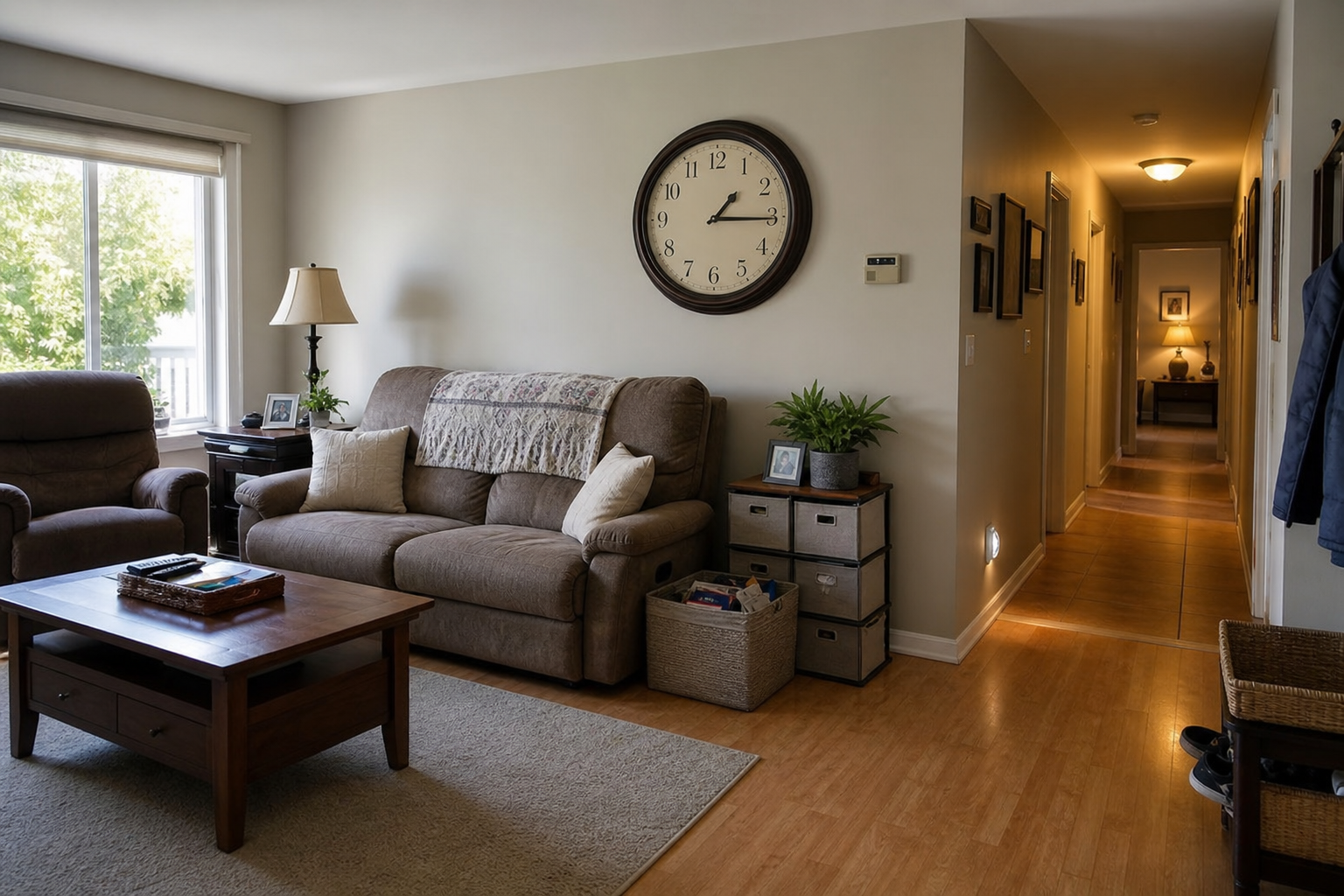
Cognitive Changes And Home Safety matters because small changes in memory, judgment, attention, or perception can make an ordinary home harder to manage safely. A person may still sound normal in conversation while quietly struggling with routines that once felt automatic.
The goal is not to treat the home like a medical facility. The goal is to make daily life easier, calmer, more visible, and less dependent on perfect memory. Simple changes often reduce risk without expensive remodeling or unnecessary loss of independence.
My father’s cognitive change was abrupt. He was cheerfully walking down the driveway of his home in Pennsylvania in February wearing light clothing when a letter carrier asked where he was going. He replied that he was going to see the Fourth of July fireworks.
My mother’s decline was much subtler and became most obvious in the kitchen. She had been an excellent cook for many years, but gradually lost the ability to prepare ordinary meals and eventually relied mostly on very simple foods and routines.
Cognitive Changes And Home Safety Begins With Pathways And Movement
The first safety risk often arises from ordinary movement through the home.
Cognitive changes can affect how a person notices obstacles, judges distance, remembers where things are, or reacts when something is out of place. A small table, laundry basket, loose cord, or dark hallway may not seem dangerous to a younger person, but it can become a real problem when attention and judgment are less reliable.
The home should be arranged so that movement requires fewer decisions. Clear routes reduce hesitation, side-stepping, reaching, and sudden course corrections.
Practical changes include:
- Remove small tables from narrow walking routes.
- Keep electrical cords against walls, not across open floor.
- Move shoes, bags, and pet items away from doorways.
- Leave enough space beside chairs for easy standing.
- Keep frequently used rooms arranged the same way each day.
- Remove decorative items from surfaces used for balance.
Cognitive Changes And Home Safety is partly about reducing surprises. The more predictable the walking path, the less the person must rely on quick judgment.
Watch For Changes In Everyday Routines
Routine changes often appear before obvious confusion.
A parent may still hold a normal conversation, answer questions politely, and appear socially capable. At the same time, daily routines may become narrower, slower, or less complete. Cooking, cleaning, dressing, laundry, bill sorting, and medication routines may show the real change first.
Families should look for practical signs, not just dramatic symptoms.
Useful signs include:
- Meals become simpler than before.
- Laundry piles up in unusual places.
- Mail is left unopened or scattered.
- Trash is not taken out regularly.
- Appliances are left on or unplugged without reason.
- The person avoids tasks they once handled easily.
Kitchen Safety Often Shows Cognitive Decline Early
The kitchen is one of the clearest places to notice changing judgment.
A person who cooked confidently for decades may slowly lose the ability to manage multi-step meals. This can happen while simple routines remain intact. Scrambled eggs, toast, sandwiches, and coffee may still be possible because those actions are deeply familiar. Full meals, baking, timing several dishes, or safely using multiple appliances may no longer be realistic.
Families should not treat this as laziness or stubbornness. It is often a sign that the kitchen setup now requires too much memory, sequencing, and attention.
Practical kitchen adjustments include:
- Keep only the most used pans within easy reach.
- Remove rarely used appliances from counters.
- Use an automatic shut-off kettle instead of boiling on the stovetop.
- Store simple, ready-to-eat foods in visible places.
- Label leftovers with large dates.
- Keep sharp knives in one predictable location.
Reduce Nighttime Disorientation Before It Causes Falls
Nighttime confusion can turn a familiar home into a risky space.
A person may wake up unsure of the time, the room, or the reason for getting up. Even mild disorientation can lead to rushing, wandering, opening the wrong door, or trying to move in the dark. Cognitive Changes And Home Safety should always include nighttime movement because many falls happen when the person is tired, half-awake, or trying not to disturb anyone.
The safest approach is to make the nighttime route obvious. The path from bed to bathroom should be short, visible, and free of decisions.
Low-cost changes include:
- Place motion-sensor night lights along the route.
- Remove rugs between the bed and bathroom.
- Keep a clear space beside the bed.
- Put a lamp within easy reach.
- Use a large clock that shows day and night clearly.
- Keep slippers in the same place every evening.
Make Bathrooms Easier To Understand And Use
Bathroom safety depends on both balance and clear sequencing.
A bathroom can become confusing when towels, toiletries, cleaners, clothing, and bath items are scattered across surfaces. The person may forget what they came in to do, reach for the wrong item, or step awkwardly while trying to solve a small problem. Wet surfaces make these moments more serious.
The goal is to simplify the bathroom so the next action is obvious. The fewer objects competing for attention, the safer the space becomes.
Helpful adjustments include:
- Keep only daily-use items on the counter.
- Store cleaning products away from grooming items.
- Use a non-slip bath mat outside the tub or shower.
- Place soap, shampoo, and towels within easy reach.
- Keep the toilet paper holder visible and easy to use.
- Remove decorative rugs that slide or bunch.
Understand Hallucinations Without Arguing About Reality
Hallucinations or mistaken perceptions should be handled calmly and practically.
A geriatric nurse told me that her mother believed the newer twenty-dollar bills were counterfeit and wanted to call the police. She said it was almost impossible to convince her otherwise because the experience felt completely real to her mother. The lesson was not to argue emotionally or try to force agreement. Patience and calm reassurance usually work better than confrontation.
My father experienced hallucinations frequently. One memorable episode happened while we were sitting together watching the news on television. He lifted his lap blanket, pointed at it, and asked, “Don’t you want to see my report card?”
I explained that he was having a waking dream and that we were actually sitting there watching television. He replied, “Oh,” and briefly seemed to accept the explanation. Then he carefully began folding the blanket.
I asked what he was doing, and he replied, “If you don’t want to see this report card, I’ll just put it away.”
Experiences like this taught me that arguing emotionally about perceived reality usually does little to help. The experience often feels completely real to the person having it. Calmness and patience usually work better than confrontation.
Some older adults see people, animals, shadows, objects, or situations that seem completely real to them. Arguing usually does not help because the experience may feel as real as anything else in the room. A safer response is to reduce distress, check the environment, and guide attention toward safety.
Lighting, shadows, reflections, patterned flooring, television noise, and clutter can all worsen perceptual problems. The practical question is not who is “right.” The practical question is whether the home can be made calmer and easier to interpret.
Useful steps include:
- Improve lighting in dim corners.
- Close curtains at night if windows create reflections.
- Remove confusing patterns from walking paths.
- Lower television volume during evening hours.
- Keep mirrors out of sightlines in dark hallways if they cause distress.
- Respond calmly before redirecting the person.
The NIA has a good page about dementia and alzheimer's disease.
Plan For Resistance To Help
Resistance is often part of the safety problem.
A person may refuse help because they do not see the risk, do not remember the incident, or feel embarrassed by the change. Pushing too hard can create defensiveness. A better approach is to make the home safer without turning every change into a debate.
Small changes work best when they feel normal. Repositioning furniture, improving lighting, simplifying counters, and removing trip hazards often creates less resistance than announcing a major safety project.
Cognitive Changes And Home Safety connects directly to aging in place and fall prevention because memory, judgment, and movement are not separate issues inside a real home.
The Aging in Place Checklist can help families notice these risks before they become emergencies.
Practical approaches include:
- Make one change at a time.
- Avoid blaming the person for accidents.
- Present changes as convenience, not control.
- Keep familiar furniture when it is still safe.
- Remove hazards gradually when possible.
- Watch how the person actually moves through the home.
When An Aging Parent Refuses Help
Helping Aging Parents Accept Help
Keep The Home Predictable Enough For Independent Living
Predictability protects independence.
When cognitive changes are present, the safest home is not necessarily the newest or most perfectly organized home. It is the home where daily actions are easy to repeat. The same chair, same lamp, same bathroom path, same medication spot, and same kitchen setup can reduce mistakes because the person does not have to solve the house again every day.
Cognitive Changes And Home Safety should focus on removing unnecessary decisions. That does not mean stripping the home of personality. It means keeping meaningful items while reducing objects that interrupt movement, obstruct visibility, or complicate routines.
Useful final adjustments include:
- Keep keys, glasses, and phone in fixed locations.
- Use open bins for everyday items instead of crowded drawers.
- Keep chairs in consistent positions.
- Remove unstable accent furniture from walking areas.
- Store seasonal clutter outside daily living spaces.
- Review the home after any fall, near-fall, or confusing incident.
See the following links for additional guidance on dementia and cognitive decline issues:
Early Signs Of Dementia In Elderly Parents
Fall Prevention For Seniors With Dementia
Hallucinations And Confusion In Dementia
How To Cope With Dementia In A Parent
Medication Mistakes And Cognitive Decline
Signs Dementia Care At Home Is Becoming Unsafe
© 2026 Mark Fomenko. All rights reserved.
AgingInPlaceResource.com
Privacy Policy | Terms of Use | Disclaimer | Contact | Newsletter
Recent Articles


-
Aging In Place Resource Library
Sep 04, 26 08:30 AM
Aging In Place Resource Library -
Aging in Place Resource Newsletter
Aug 30, 26 11:16 AM
Aging in Place Resource Newsletter -
Aging in Place Resource: Simple Strategies for Living Safely at Home
Jul 28, 26 12:43 PM
 Aging in Place Resource provides practical guidance for aging in place. Learn how to live safely and independently at home with strategies for home safety, caregiving, planning, and long-term support.