Aging in Place Home Safety Assessment
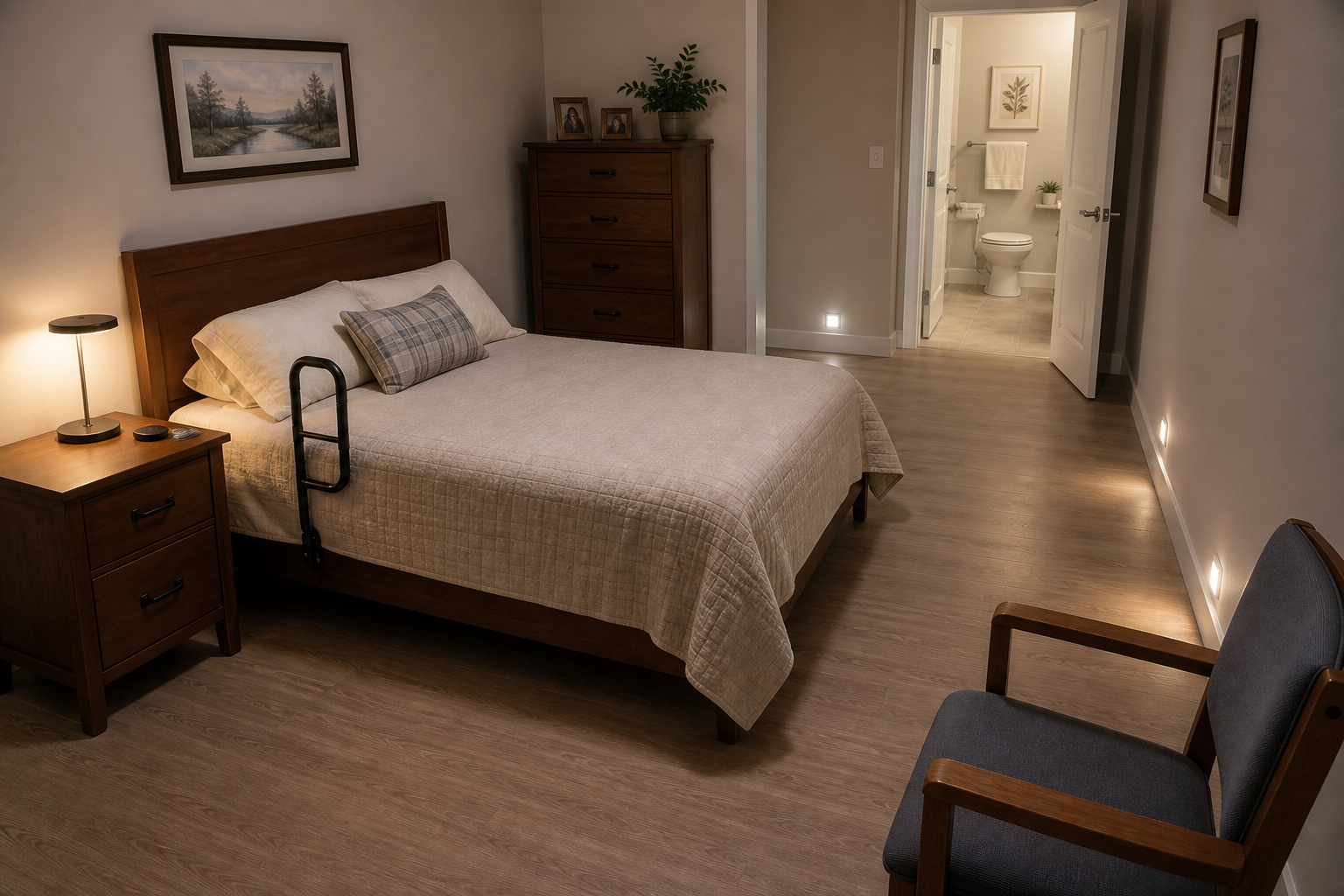
An Aging in Place Home Safety Assessment is a structured way to identify hazards that can lead to falls, injuries, or loss of independence inside the home. Most risks are not obvious until a problem occurs, which is why a systematic review of the environment is essential.
Bedrooms are high-risk areas because they involve transitions between lying, sitting, and standing, often in low light and when the body is least stable. A prevention mindset focuses on controlling the environment so movement is predictable, supported, and safe at all times.
This guide breaks the assessment into practical steps you can apply immediately.
Bedroom Safety For Seniors Starts With Bed Height And Stability
Bed height and frame stability directly affect safe transfers in and out of bed. An effective Aging in Place Home Safety Assessment begins here because a poor bed setup is a common cause of falls during nighttime movement.
The bed should allow the user to sit with feet flat on the floor and knees at a natural angle. If the bed is too high, sliding off becomes unstable. If too low, standing requires excessive effort and balance.
A stable bed frame prevents shifting during transfers. Lightweight frames or those on wheels without locks introduce instability that increases fall risk.
• Sit on the edge of the bed and ensure both feet rest flat on the floor
• Adjust bed height using risers or by removing the box spring if needed
• Test the frame by pushing sideways to check for movement
• Lock any wheels or replace them with fixed legs
• Position the bed so one side has clear access for movement
A properly set bed creates a controlled starting point for all nighttime movement.
Safe Nighttime Pathways Must Be Clearly Defined
A clear path from bed to bathroom is essential for reducing nighttime fall risk. During an Aging in Place Home Safety Assessment, this pathway should be treated as a primary movement corridor.
Clutter, rugs, and poorly placed furniture create unpredictable obstacles. At night, even small objects can become serious hazards.
Lighting must support visibility without requiring complex actions. Motion-activated lighting is ideal because it removes the need to search for switches.
• Remove all loose rugs along the path
• Keep pathways at least 30 inches wide
• Install motion-activated night lights along the route
• Secure electrical cords against walls
• Avoid placing furniture in direct walking paths
Lighting Design Should Support Immediate Visibility
Lighting must be consistent, layered, and easy to activate. In an Aging in Place Home Safety Assessment, poor lighting is one of the most common and correctable risks.
Overhead lighting alone is not sufficient. Shadows and dark zones increase the chance of missteps. Bedside lighting should be reachable without leaning or twisting.
Switch placement matters. If a person must walk in the dark to reach a switch, the system has already failed.
• Place a lamp within arm’s reach of the bed
• Use touch-activated or motion-based lighting when possible
• Ensure hallway lighting activates automatically
• Replace dim bulbs with brighter, warm-toned options
• Add low-level floor lighting for visual guidance
How to prevent falls in the home
Flooring Surfaces Must Be Stable And Predictable
Flooring consistency is critical for balance and traction. An Aging in Place Home Safety Assessment should evaluate every surface for slip risk and transition hazards.
Changes in flooring height or texture can cause hesitation or missteps. Slippery surfaces increase the risk of falls, especially when combined with socks or smooth footwear.
Carpet edges, thresholds, and uneven surfaces should be corrected or removed.
• Remove or secure all area rugs with non-slip backing
• Repair uneven flooring or raised edges
• Install non-slip coatings on hard floors if needed
• Ensure transitions between rooms are level
• Avoid polished or glossy finishes that reduce traction
Furniture Placement Should Support Movement And Balance
Furniture should act as support, not obstacles. During an Aging in Place Home Safety Assessment, placement should be evaluated based on movement patterns, not aesthetics.
People often rely on nearby surfaces for balance. If those surfaces are unstable or poorly positioned, they create risk instead of support.
Spacing between furniture must allow for natural walking without turning sideways or squeezing through gaps.
• Position sturdy furniture within reach of common walking paths
• Remove lightweight or unstable pieces from high-traffic areas
• Maintain consistent spacing between major furniture items
• Avoid sharp corners near walking paths
• Ensure chairs and surfaces do not shift when leaned on
Furniture should support movement not only in the bedroom but also in transition zones that lead to higher-risk areas. Many falls occur when moving from stable surfaces in the bedroom into less controlled environments like bathrooms, where flooring, moisture, and tight spacing increase risk. Evaluating furniture placement as part of a larger movement system helps ensure that support does not disappear at critical points.
Bathroom Access Must Be Immediate And Safe
Bathroom access is one of the highest-risk transitions in the home. An Aging in Place Home Safety Assessment must ensure the route and entry are safe under all conditions.
Urgency often leads to rushed movement, which increases the risk of falls. The environment must compensate by being simple, clear, and predictable.
Doorways should open easily, and lighting should activate without delay.
• Keep the bathroom door unobstructed at all times
• Use lever-style handles instead of round knobs
• Install grab bars near entry points if needed
• Ensure lighting activates before entering the space
• Keep floors dry and free of clutter
https://medlineplus.gov/ency/patientinstructions/000021.htm
Transfer Safety Requires Consistent Support Points
Transfers from bed to standing and from standing to walking require controlled support. An Aging in Place Home Safety Assessment should identify where assistance is needed during these movements.
Support points should be stable, predictable, and always in the same location. Inconsistent support leads to hesitation and imbalance.
Training the body to rely on specific, stable surfaces improves safety over time.
• Install a bedside grab bar or rail if needed
• Use a sturdy chair near the bed for seated transitions
• Keep assistive devices within reach at all times
• Avoid relying on movable objects for support
• Ensure footwear provides traction during transfers
An Ongoing Aging in Place Home Safety Assessment Prevents Future Risks
An aging in place home safety assessment is not a one-time task. Conditions change, and risks evolve. Regular review ensures the environment continues to support safe aging in place.
Small changes, such as adding furniture or moving items, can introduce new hazards. Periodic reassessment keeps the system aligned with current needs.
Focus on observation. Watch how movement actually occurs, not how it is intended.
• Re-evaluate pathways every 3 to 6 months
• Check lighting systems for failures or dimming
• Monitor changes in mobility or balance
• Adjust furniture placement as needed
• Remove new clutter before it becomes permanent
_____________________________________________________________________________________________________
Get clear, practical insights on aging in place sent occasionally, and only when useful.
No spam. No noise. Unsubscribe anytime.
______________________________________________________________________________________________________