What Is An Aging In Place Resource
Understanding what is an aging in place resource gives you an advantage. It allows you to recognize risks earlier, make targeted improvements, and avoid rushed decisions that often lead to unnecessary costs or loss of independence.
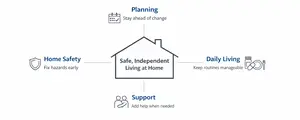
An aging in place resource is not just a collection of tips or general advice. It is a practical system designed to help people stay safe, independent, and in control while continuing to live in their own homes as their needs change over time.
Most people assume they will figure things out later. In reality, problems tend to appear suddenly. A fall in the hallway. Difficulty getting in and out of the shower. Missed medications. These situations rarely develop all at once, but they become visible only when risk has already increased.
If you are new to this process, begin with the Start Here with Aging in Place Resource page to understand how to apply this system step by step.
What Is An Aging In Place Resource In Practical Terms
When people ask what is an aging in place resource, they are usually looking for something simple. A checklist. A few safety tips. Maybe a list of products.
That is not enough.
A true aging in place resource is a structured approach to managing risk inside the home over time. It focuses on how people actually live, move, and adapt within their environment.
In practical terms, an aging in place resource should help you:
- Identify risks inside the home before they cause injury
- Make targeted safety improvements that match real conditions
- Adjust the environment as mobility, balance, and health change
- Plan for support without giving up independence
- Avoid reactive decisions made under pressure
This is the difference between reacting to problems and preventing them.
What You Will Find In This Aging In Place Resource
This aging in place resource is designed to move from awareness to action.
Instead of offering disconnected advice, it provides a system that can be applied repeatedly as needs evolve.
You will find:
- Room-by-room safety breakdowns
- Step-by-step home assessment guidance
- Prioritized fix lists based on real risk
- Practical examples based on everyday situations
- Decision frameworks for when to make changes
- Guidance for adding support without losing independence
If you want to begin immediately, use the Aging in Place Checklist to identify risks in your home and prioritize what to fix first.
Where Problems Typically Start
Understanding what is an aging in place resource also means understanding where problems usually begin.
Most issues are not random. They follow predictable patterns.
They tend to occur in:
- Bathrooms
- Stairs and hallways
- Bedrooms
- Kitchens
- Entryways
These are areas where movement, speed, and routine intersect.
Common real-world situations include:
- Getting up at night without turning on lights
- Carrying items while navigating stairs
- Stepping over objects that have become part of daily routine
- Reaching for items stored too high or too low
If you want a deeper breakdown of these risks, see How to Prevent Falls in the Home, where these patterns are explored in detail.
The Most Common Mistakes
A major reason people search what is an aging in place resource is because something has already gone wrong.
The goal is to avoid that situation entirely.
Common mistakes include:
- Waiting until after a fall to make changes
- Assuming being careful is enough
- Ignoring small difficulties that signal larger issues
- Making partial fixes instead of addressing root causes
- Overlooking lighting as a major factor
Falls are one of the leading causes of loss of independence. Most happen in situations that are predictable and preventable.
An effective aging in place resource focuses on prevention first.
The Highest-Impact Changes To Make First
Some improvements provide immediate safety benefits with minimal effort.
Improve Lighting
Poor visibility is one of the most consistent contributors to falls.
Focus on:
- Hallways and stairways
- Bathroom entrances
- Bed-to-bathroom pathways
- Entry points
For expanded guidance, see Home Safety for Seniors, where lighting strategies are covered in more detail.
Remove Tripping Hazards
Loose and uneven surfaces create unnecessary risk.
Address:
- Throw rugs without non-slip backing
- Electrical cords across walkways
- Clutter in high-traffic areas
- Uneven flooring transitions
Add Support Points
Support reduces instability and hesitation.
Install:
- Grab bars in bathrooms
- Handrails on both sides of stairs
- Non-slip surfaces in wet areas
For a deeper dive into bathroom-specific risks, review Bathroom Safety for Seniors.
How To Know When Action Is Needed
Another reason people ask what is an aging in place resource is uncertainty about timing.
Many wait too long because nothing has gone wrong yet.
In reality, warning signs appear early.
You should act now if you notice:
- A recent fall or near fall
- Difficulty getting in or out of bed or the shower
- Holding onto furniture for balance
- Avoiding certain rooms or stairs
- Inconsistent medication management
- Fatigue during routine tasks
These are indicators that the environment no longer matches current ability.
This is the ideal time to use an aging in place resource.
How To Evaluate Your Home
A practical home evaluation does not require professional training.
Walk through your home and observe:
- Where movement feels rushed or unstable
- Where lighting is insufficient
- Where balance is needed but not supported
- Where reaching or bending is frequent
Ask simple questions:
- Is this safe at night?
- Would this still work with reduced mobility?
- Would someone unfamiliar feel confident walking here?
To turn this into a structured process, use the Aging in Place Checklist, which breaks evaluation into clear steps.
Room-By-Room Risk Breakdown
Understanding what is an aging in place resource includes recognizing that each area of the home has unique risks.
Bathroom
This is the highest-risk area.
Common issues include:
- Slippery surfaces
- Limited space for movement
- Lack of support points
Solutions are covered in detail in Bathroom Safety for Seniors.
Bedroom
Most problems occur during transitions.
Risks include:
- Getting up too quickly
- Poor lighting at night
- Using unstable furniture for support
Kitchen
This area combines movement, heat, and sharp objects.
Typical issues include:
- Reaching overhead
- Carrying heavy items
- Standing for long periods
Stairs And Hallways
These are high-risk movement zones.
Problems include:
- Poor lighting
- Missing handrails
- Cluttered pathways
For full coverage, refer again to How to Prevent Falls in the Home.
Planning For Change Over Time
An aging in place resource must account for change.
Mobility, balance, vision, and strength do not remain constant.
Plan for:
- Reduced flexibility
- Slower reaction times
- Increased need for support
- Possible use of assistive devices
Examples of early adjustments include:
- Wider pathways
- Step-free entry points
- Lever-style door handles
Planning ahead reduces the need for major changes later.
When To Add Support
Independence does not mean doing everything alone.
Consider outside help when:
- Daily tasks become physically difficult
- Medication management becomes complex
- Safety risks increase despite changes
- Recovery from illness or injury is slow
Options include:
- Part-time in-home assistance
- Transportation services
- Meal preparation support
- Monitoring systems
The goal is to extend independence, not replace it.
How To Use An Aging In Place Resource Effectively
Understanding what is an aging in place resource is only the first step.
The real value comes from applying it consistently.
Use a simple system:
- Identify risks
- Prioritize high-impact changes
- Make targeted improvements
- Reassess regularly
- Adjust as needs change
Avoid trying to fix everything at once. Focus on what matters most now and what will matter in the near future.
Why Early Planning Changes Outcomes
Delaying action leads to:
- Decisions made under pressure
- Higher costs
- Reduced options
Early planning allows:
- Better decisions
- Lower costs
- Gradual adjustments
- Greater control
This is where an aging in place resource provides the most value.
Using This Resource As A Starting Point
This page explains what is an aging in place resource and how it works in real-world conditions.
To take the next step:
- Use the Aging in Place Checklist to identify risks
- Explore Aging in Place Guides for deeper solutions
- Refer to Tools & Resources for additional support
For research-based guidance, review materials from the Centers for Disease Control and Prevention, which provide data-driven fall prevention strategies.
Final Practical Takeaway
An aging in place resource is not about theory. It is about reducing risk in the exact places where daily life happens.
Focus on:
- Lighting
- Stability
- Clear movement paths
- Practical support points
- Early planning
Most problems are predictable.
The advantage comes from addressing them early, before they become urgent.
To move from understanding to action, start with the Aging in Place Checklist and begin evaluating your home today.
© 2026 Mark Fomenko. All rights reserved.
AgingInPlaceResource.com
Privacy Policy | Terms of Use | Disclaimer | Contact | Newsletter
Recent Articles


-
Aging In Place Resource Library
Sep 04, 26 08:30 AM
Aging In Place Resource Library -
Aging in Place Resource Newsletter
Aug 30, 26 11:16 AM
Aging in Place Resource Newsletter -
Aging in Place Resource: Simple Strategies for Living Safely at Home
Jul 28, 26 12:43 PM
 Aging in Place Resource provides practical guidance for aging in place. Learn how to live safely and independently at home with strategies for home safety, caregiving, planning, and long-term support.